DEMO_TFJIGSAWSEP - - Decomposition of an audio signal into tonal, transient and residual layers
Description
This demo shows how to use tfjigsawsep, where a signal is decomposed into its tonal, transient and noisy residual layers.
The algorithm is based on [1]. It transforms a signal into a two-windowed Gabor expansion such that one wide window shall lead to a high frequency resolution (tonal layer is represented well) and a narrow one to a high time resolution (transient layer is repr. well). The resulting Gabor coefficients in the time-frequency plane are grided adaptively into rectangular 'supertiles', whithin one by one an entropy criterion decides, which layer of the signal (tonal, transient) is represented better. This tile will be kept if it is below a certain threshold, the other one is thrown away. After running through the whole tf-plane, the respectively leftover Gabor coefficients are transformed back and substracted from the original signal. By applying this procedure iteratively, tonal and transient layers emerge. A second version of the algorithm is available. Here the entropy criterion chooses those tiles, where the tonal part of the signal is represented better and is below a given threshold. The rest is set to zero. The leftover Gabor coefficients are transformed back and substracted from the original signal. Then the same is applied again to choose those tiles, where the transient part is represented better. After that, one gets the first approximation of the two layers. By applying this procedure iteratively on the residual, tonal and transient layers emerge.
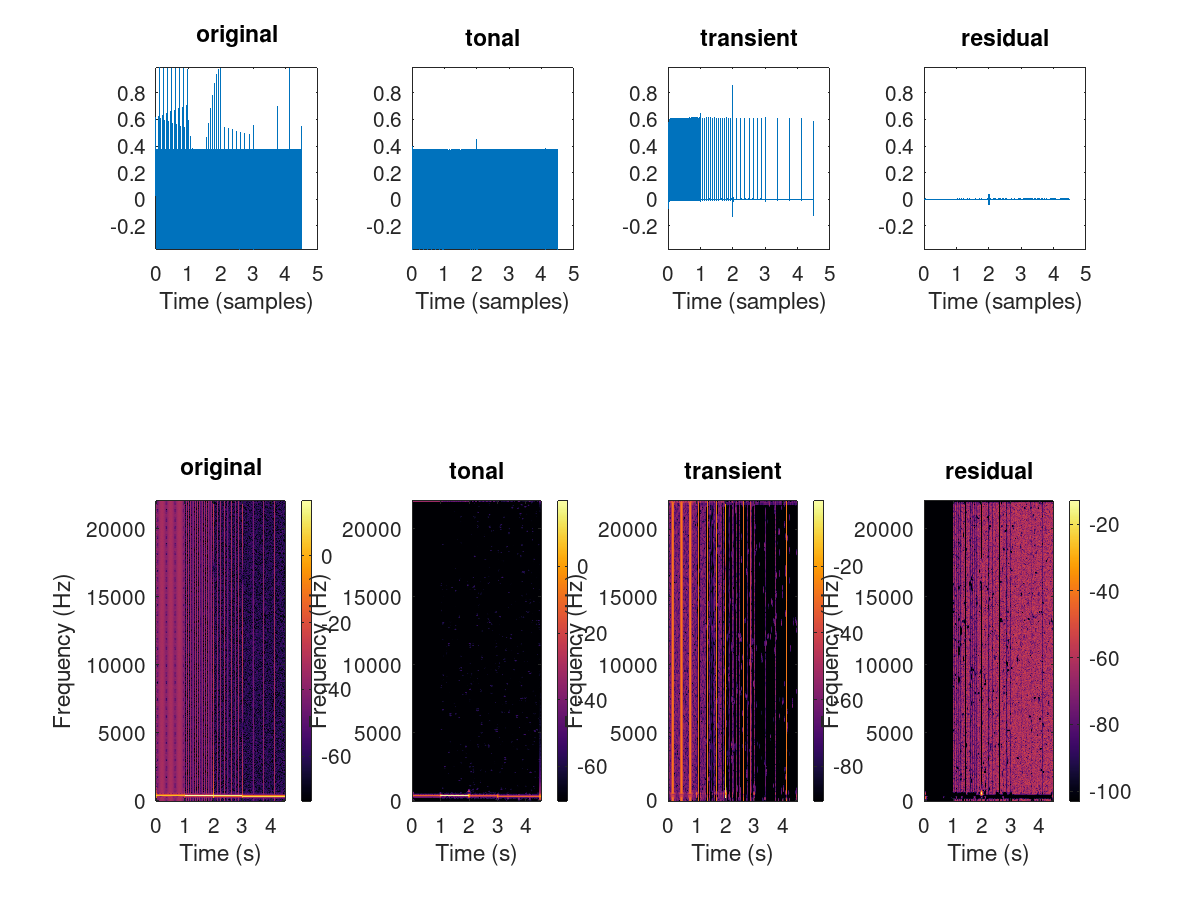
Separated layers
References:
F. Jaillet and B. Torrésani. Time-frequency jigsaw puzzle: Adaptive multiwindow and multilayered gabor expansions. IJWMIP, 5(2):293--315, 2007.